Tuesday, December 8, 2015

Donald Trump: How he did it.

I investigated the phenomenon that is Donald Trump. He entered the 2016 a laughing stock and not seen as serious candidate for president. He managed to accomplish the seemly impossible by climbing to the top of the polls and becoming the front runner of the GOP for the last 5 months. I examined the many circumstances and criteria that made this possible and analyzed it using various media theories and philosophies. I discovered that Trump is a master media manipulator, an orchestrater of social media as well as having a huge following on Twitter and other platforms, and is a spectacle that the american people and media love to watch and he gives them a reason to watch him. I believe that with what I uncovered Trump will continue his triumphant march to the white house and become president of the United States. Despite the lack of support from the liberal college student as shown in research conducted in front of my class:


Published:http://www.grin.com/en/e-book/311874/how-donald-trump-broke-politics
(Note: I have no idea why there is a price, it was supposed to be a free text.)

No One Wants to be Debbie 12 8 2015 teaser


Daniel M Koo
Convergence
12/10/2015

            Born and inspired by the idea of cell phone deprivation in our media and internet heavy present day, “No One Wants to Be Debbie,” is my short comedy that plays with the subject. Though only a trailer now, I plan to finish this film and show frustration and boredom overtake the young protagonist.

            I normally work in comments, not messages, and this gave me a little bit of trouble when approaching this particular project. I liked poking fun at the fact that many of us picture ourselves as being much stronger than we are in a variety of ways. With this, “end of the world,” style scenario, something no one thinks would ever happen to them until it finally does, I found it fun to dream up and write certain sight gags, we will end up seeing in the finished film. If the internet shut down today, how would it affect us? Do we return to how we lived our lives before the digital age? Or do we freak out until we eventually decide to pull ourselves together? There is a slow degeneration of the character’s persona throughout the film because of ideas like these. Also I thought it would be fun to put a fictional character through hell.

Thursday, December 3, 2015

We are Transmedia Experts

        Today Transmedia Storytelling, or rather a transmedia lifestyle is the only way to truly get ahead in this media savvy world. People like Kim Kardashian have used transmedia to appeal to the masses, giving them a reality show, a video game, a twitter account, and websites dedicated to more of her: more beauty, more fashion, more sex. In the book Convergence Culture by Henry Jenkins, he discusses how the Matrix used transmedia storytelling to give viewers more, and to tell a more complete story. According to Jenkins, "The Wachowski's wanted to wind the story of the Matrix across all of these media and have it all add up to one compelling whole. (103)" Transmedia does not replicate, creating the same thing and thinly spreading it across different media, that is called multi-media. Transmedia adds layer, upon layer, until the viewer has a huge 6-foot long sandwich comprised of perfect ingredients to make the perfect whole.
        The Wachowski brothers used video games, comic books, other movies, alternate trailers, books and magazines to tell a fuller story, to tell more than what the movie gave, and to give die-hard fans a more complete view of the story. Jenkins states that the gaps in storytelling, like failing to introduce characters before they pop onto the screen can confuse the audience, and detract from the value of the movie, if watched alone, but this is the new Hollywood. According to Jenkins, 'The new Hollywood demands that we keep our eyes on the road at all times, and that we do research before we arrive at the theater. (106)" Transmedia makes the viewer into more than a spectator, they must actively participate in order to get the full picture.
Movie poster for Animatrix, a series of short films by Peter Chung, Yoshiaki Kawajiri, Koji Morimoto, and Shinichiro Watanabe centered around The Matrix

        The problem with Transmedia is that not everyone wants to have to play a games, or read a magazine, to understand the movie, some people just want a full and complete film. But, the positive aspects of transmedia far outweigh the negatives in financial prospects. In The Matrix Trilogy, Jenkins informs readers that the Wachowski Brothers employed other artists, graphic designers, writers and movie makers to bring new life to the characters and add to the storyline. the revenue going into each aspect of the media empire allowed for numerous people to reap the economical benefits. 
        In an article by Erik Wecks, "Technology and Storytelling Part 2: Transmedia Novels? Still 5 Minutes in the Future", Wecks speaks about Henry Jenkin's definition of transmedia storytelling, but also discusses"Brian Selznick’s The Invention of Hugo Cabret — a transmedia work of art which is both groundbreaking in the way it tells its story and breathtaking in its flawless execution." According to Wecks, Cabret's numerous mediums never have the full story, the pictures and the text seamlessly go back an forth, giving the viewer a fuller story. This is what makes transmedia such an art form, and why it is soimperative for all media entrepreneurs to live in multiple media outlets with different content.
          The most famous bloggers, and Youtubers are transmedia experts, whether they know it or not. they simultaneously produce content for Youtube, or their blogs, while producing side content for their Instagrams, Twitters, Snapchats, Pinterests, and more. Each of these media channels call for different content making it easy to tell a transmedia story about your life. A beauty blogger that calls herself Alyssa Forever began on Youtube making videos about hair, makeup, and fashion, and has grown her fan-base to hundreds of thousands of beauty followers. She mastered the art of Youtubing, curating her channel to give people beauty tips, and curating her Instagram to give small slices of her fuller story. She entices the viewer to want to learn more. Women flock to beauty bloggers, aspiring to be as 'beautiful',  or 'flawless', and acquire the looks and makeup that they have. 
This is a photo of the beauty blogger, AlyssaForever showcasing her full wig in a style that makes the wig aspect unbelievable!

         Even Christians are utilizing transmedia storytelling. Hillsong Church, a worldwide church with numerous bands, lives on Youtube, Vimeo, their own website, Instagram, Twitter, and a movie about Hillsong United, a Hillsong choir/band based in Australia, director by Michael John Warren. each facet of their media campaign makes it possible for fans to get more, to know more, and to understand their beginnings and who they are. Click this to get more info about the Hillsong movie
Artsist like Hillsong United make music to spread the love of Jesus and save souls, and more and more people are being blessed by the music that they produce, but today, people want to know more. Viewers want to know what the lead singer, Taya Smith eats, how she dresses when she is not on stage, and if she really is as "Christian" as she seems, and her Instagram, or Twitter account gives viewers the illusion that they know more, that they know her. We have the ability to interact, to ask, and hope for responses, to tell our friends what the people we love ate for breakfast. This is transmedia in the new age.
        For anyone of us to be relevant in this moving world, and to grab and keep audiences, we must give them more. One big thing isn't enough because there are people that want more, that exist to want more, people that search. For any one of us to be relevant and popular, we have to give the allusion of giving more than people ask for, we have to live on multiple media platforms, and we have to provide different things on all of them. If we are you tubers, we have to have Instagrams that give sneak peeks to our videos. And if we are writers, we have to take on the role of Baratunde and give the whole timeline of our writing, and we have to do this is we ever want to gain exposure, and get the millions of people who's fascination lies in cat videos, and ratchet TV. If we want to change everything, or even anything, we have to do this. Jenkins stated that, "More and more consumers are enjoying participating in online knowledge cultures and discovering what it is like to expand one's comprehension..." Although Hillsong, and AlyssaForever may not have as large of a storytelling community as The Matrix, or Lord of the Rings, they are small examples of how we can make social media work for us.


Works Cited:
 Jenkins, H. (2006). Convergence culture: Where old and new media collide. New York: New York University Press. 

 Wecks, E. (2012, October 26). Technology and Storytelling Part 2: Transmedia Novels? Still 5 Minutes in the Future. Retrieved December 4, 2015, from www.wired.com 

http://hillsongmovie.com


Picture courtesy of AlyssaForever's Instagram: https://www.instagram.com/p/-ky0c5tTsh/?taken-by=foreverflawlyss

 Picture of Animatrix photo courtesy of: http://movieposters.2038.net/p/Animatrix_3.jpg 

In The Year 2100...

Late Night With Conan O'Brien                       Courtesy NBC


Convergence has changed over the course of time. To ask what the future of it is, where it is headed , is a tough question for anybody to answer. For “the future has not been written. There is no fate but what we make for ourselves.” This is of course not the line from a media studies expert or a great philosopher but a line from the Terminator movies. But I think it answers the question in the best way possible. It is difficult to determine the future of anything but an educated guess can be made and might still be way off. Back to the Future II (1989) is a great example of guessing the future of convergence. 
BTTF II Predictions              Photo Credit: Vox.com

  The film depicts the Hill Valley of today from 1989. While some things proved to be true like 3D movies and video chatting, others proved to be way off like the fax machines being popular. With that being said I’ll be making my own predictions for what I think the media landscape will be like in the year 210 . Anyway, convergence is making its way more to the control of the people. It’s important to note that “the public will not rethink their relationship to media content overnight.” (Jenkins 255). It will most definitely be a gradual process as we are already beginning to see. Media is making its way into the control of the consumer and less from the companies and corporations. In the year 2100 TV networks will no longer exist. Shows will be distributed directly to the consumer either digitally online or by blu-ray discs. Unfortunately, there will only be one show on the air, Jerry Springer.  And it’s not just mainstream media that will change but the dynamics of politics.
            
While politics has been evolving over the last decade or so, so has the campaigning and coverage of it, and there are no signs of slowing either. User submitted questions are now a staple of televised debates and is something that politicians have to get used to. Jenkins talks about the 2008 CNN democratic debate Snowman video controversy.
There were some like Mitt Romney who felt tactics like that are a joke and are insulting to politicians who want to talk about the issues seriously. On the other hand some saw it as light hearted and felt that politicians should have a sense of humor about it. With the way media and the convergence of media is heading, politicians can expect more it. In fact, recently there has been controversy and problems with the Republican debate and their moderators. I wouldn’t be surprised if in the year 2100, CNBC moderators will be replaced entirely by users skyping in and asking questions directly to their favorite candidates. In a related story CNBC will call their moderators “users.”

            I think we can only look ahead so far but perhaps the past can serve as a barometer of what we can expect. History tends to repeats itself and we can use the past as a guide to the future. There has been a constant move from media to media, with one overtaking the other. But at the same time spanning across those platforms and forming bridges between media. 
                               Photo credit: create.ou.edu
 Jenkins says “Convergence represents a paradign shift—a move from medium-specific content that flows across multiple media channels, toward the increased interdependence of communications systems, toward multiple ways of accessing media…” (Jenkins 254) In the year 2100 there will be a single device that will allow people to watch a video/tv, allow gameplay, and allow the consumer the share and contribute with other users. It will become so popular the television will become obsolete. Unfortunately, it will only be only be able to play episodes of Keeping Up With the Kardashians and The Ropers.


            It is important for us to realize that there is a transfer of power happening between media conglomerates and the consumer.  However this can result in dire consequences. Videos and content can be churned out at an enormous rate resulting in consumption that is just as fast and perhaps not having the effect that the creator had intended on his audience. Filmmaker, Michael Moore talked about how after completing Capitalism: A Love Story back in 2009 he would stop making movies because his intention was to make change and have the American People react to his films and become more active. As Chuck Tyron argues “that the speed with which such videos are produced and circulated can undercut the desired pedagogical and activist goals, sparking short-lived and superficial conversations among consumers who are always looking over their shoulders for the next new thing. (Jenkins 290). People are less likely to actually care about the cause then to express their thoughts in short controversial blurbs. 
Clip Courtesy NBC

Media has changed the whole landscape of activism. 50 years ago there were people marching and getting thrown in jail simply for fighting for what they believe in. Today people there are still some activists; many are not quite active enough. Many comment or tweet and perhaps spark conversations that could be deemed offensive or provocative.

            
And so we look ahead at a future that has the potential of becoming something amazing and radically different than what we have today. But there is also the risk of things becoming unimaginable and disastrous, with the merging of companies and the democratizing of media, thus ending the decade’s long control of the gatekeeping media professionals. We must decide now on the future of media convergence and where we want to be in the future. 


We must make convergence great again!

Notes:

Jenkins, Henry. "Conclusion and Afterward." Convergence Culture: Where Old and New Media Collide. New York: New York UP, 2006. 220-260. Print.

Tahir Russell:Future of Convergence Extra Credit


Tahir Russell
Convergence
Professor Caçoilo
Convergence

            Convergence is the change of media over the course of time through intersections of various forms of other media.  It is the technological, industrial, cultural and social changes in the ways media circulates within our culture.  The broadest term of convergence is described as a situation in which multiple media systems coexist and where media content flows fluidly across them. Convergence will continue to grow and change, as media industries think of new ways of selling content to consumers.  Transmedia is a concept that companies are beginning to take advantage of because of the revenue that it brings them.
           
            Consumers of companies always want more; transmedia is a way of getting the people more while still telling a story on a different platform. “Offering new levels of insight end experience refreshes the franchise and sustains consumer loyalty”(98 Jenkins). Companies that can keep up with fan interests and expand their franchise across multiple platforms tend to due much better than companies that do not utilize transmedia storytelling.  The knowledge we have now on media and its changes can be used in our approach to the future changes of media.

              In order to approach the future of media with our knowledge in our existence we need to understand how it is changing. Media is changing across multiple platforms all the times. Social Media is becoming a big place where media companies are spreading their information and network. Social Media such as Instagram and Facebook are now used for ads as a way to get consumers to buy their products. Along with ads a new form of marketing called viral marketing is a new way to distribute advertisements. “Viral Marketing relies on promoting a product, service, or brand through natural communication channels online, in which people spread the message because they want to, not because they are being paid to”. The personalization of media and technology seems to be where the future of media is headed.
            

                 Virtual and augmented reality seems to be where the future of gaming and other media technologies are headed. We are in an era where technology is always around us and over our bodies, Samsung and Apple’s version of a phone on your wrist are examples of this. People always have their smart phones with them, almost as if it is a part of their body. It makes perfect sense that there would only be something else that would be an extension of technology to go over our bodies to make the experience feel more realistic. Palmer Luckey founder of the Oculus headset said, “In this sense, games are very much pioneering Virtual Reality. It’s going to expand into a lot of other things like education, medicine, emergency response training and things like that,” enthuses Luckey. “Mostly it is going to start with gaming, and that’s because the games industry has all of the tools and the technology to build immersive real-time 3D worlds” (GamesRadar). Essentially these gaming experiences are starting to appear more lifelike and will hopefully be a catalyst to expand into other new developments as well.
             
          As the experiences and media development begins to change so does the capability to contact those who seemed out of reach. During last elections Democratic debate for Presidency, candidates were asked questions by YouTube vidoes, “average” citizens as they were called. Candidates were then prompted to answer those questions from YouTubers(Jenkins 272). This is the way of the future, regular people have the ability to connect to those who seemed out of reach. 


            Stuart, Keith. "16 Trends That Will Define the Future of Video Games." The Guardian. N.p., 23 July 2015. Web. 02 Dec. 2015. 

  Luckey, Palmer. ""Virtual Reality Is Inevitable" - Palmer Luckey Tells Us about the Future of Gaming." GamesRadar+. N.p., 02 Sept. 2015. Web. 01 Dec. 2015. 

 Jenkins, Henry. Convergence Culture: Where Old and New Media Collide. New York: New York UP, 2006. Print.

Blog Post 4 - Extra Credit

    Future of Convergence

The future of convergence is both bright but uncertain. What is certain however is that media convergence will continue to expand and encompass more aspects of our lives. We are only in the first few years of the internet age so there is no way of knowing where it will end, but we do have an idea of where it is going. But to get an idea of where it is going, we can look to the recent past to get an idea.

The popularity of comic book characters recently can also be seen as an aspect of convergence. Just in the last week, the trailers for Batman Vs. Superman and Captain America:Civil War, both mash-ups of multiple comic book characters fighting each other, premiered on Jimmy Kimmel Live and were posted on the internet almost immediately[1][2]. The Batman Vs Superman trailer has garnered nearly 750 thousand views in less then 12 hours, while the Civil War trailer has had nearly 35 million in the week it's been uploaded on youtube. Meanwhile, on television, both major comic book companies, DC and Marvel, have fertile television productions both on cable and Netflix. This popularity is sure to grow with DC launching their own super hero universe next year with the release of Batman vs Superman.

In politics, convergence is playing a growing roll as well. President Obama was the first president to really make use of the internet in his campaign for presidency. His use of it allowed him to organize and get his views out, for very little cost as well, because using youtube to release videos is much cheaper then buying air time on television[3]. Similarly, Donald Trump has seen an incredible amount of support from the republican side, mainly because he tailors his campaign around slogans that create create controversy and garners headlines[4]. His campaign is based around spectacle, a phenomenon that grows because with so much information being created, spectacle makes his campaign stand out.

Video games, perhaps the newest story telling medium in the world, is constantly changing and is probably the medium most changed by convergence. Steam is a service created to sell games exclusively online, forgoing physical copies all together. To encourage independent game development, Valve, Steam's developer and owner, has introduced methods of getting people's game out there. Steam Greenlight and Early Access are examples of this. Early Access is a tool where people can release their games for a price before the game is finished, which in theory, would help the games development because the profits from sales would be used to further update and develop the game[5]. Mass amateurization is important and relatively easy with video games because they can be made relatively cheaply and with few people. Similarly, Greenlight allows users to vote on what games will be released on the main steam sale platform, a way of filtering the wave of amateurization[6].

The media convergence is an unprecedented event in our culture and there is really no way to know where we are going. It is, however, ever expanding and it will only become more important in out culture. Politics will become more and more dependent on involving citizens as well as having to gain their attention in a time where everything is grabbing everyone’s attention. As time passes, it will also become harder and harder to make your own voice or vision heard because of the constant influx of new and rehashed content that floods the “airwaves”. While the future is uncertain, it is certainly exciting.


Bibliography
[1]- http://money.cnn.com/2015/12/03/media/batman-v-superman-trailer-jimmy-kimmel-live/
[2]- http://money.cnn.com/2015/11/25/media/captain-america-civil-war-trailer-jimmy-kimmel-live/index.html?iid=EL
[3]- http://bits.blogs.nytimes.com/2008/11/07/how-obamas-internet-campaign-changed-politics/
[4]-http://www.digitaltrends.com/opinion/donald-trump-works-the-internet-better-than-you-do/
[5]-http://store.steampowered.com/earlyaccessfaq/

[6]-http://www.ghacks.net/2012/09/02/what-is-steam-greenlight/

Sunday, November 29, 2015

DC's Hybrid Media

Everyone knows, or has at least heard of, what multimedia is. It is, as One 3 Productions beautifully and compactly put it in their video, “telling a single story in multiple mediums.” It is one story being told over and over again in different formats such as film, television, novels, and even video games. This used to be the main strategy companies used in order to get their product to a wide variety of audiences. The main problem that faces this strategy is that if one person did not like the story in the book, they wont give it the time of day in any other format because it is the same story. This is where transmedia comes into play. 

Transmedia, as defined again by One 3 Productions, is “telling multiple stories over multiple mediums that fit together to tell one big pervasive story.” There is one problem I have with that definition and it is at the end. Saying it fits together to tell one big pervasive story sounds like multimedia. I would prefer to say that it fits together to showcase one big pervasive world or universe. One story within the big pervasive world that is being told in one or many different formats. The access points within the world are now numerous, and this is the main difference with transmedia and multimedia. Now, multimedia is a cog in the bigger machine that is transmedia. One person can choose what ever format they want and whichever story they want and they are then able to enter that world.

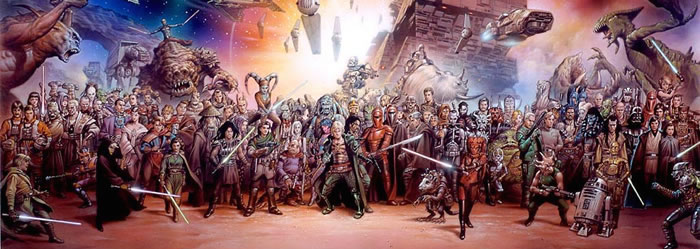
There are many examples of this in todays media. We have Star Wars, which not only has multimedia elements (Episode I is currently available as a film, book, video game, and graphic novel) but bigger transmedia elements as well (There are numerous characters in the Star Wars universe whom each have their own stories, and those stories are told in various formats). The only catch (for lack of a better word) to Star Wars is that Lucasfilm, and now Disney, have made a great effort to make sure that every story told within the Star Wars universe coincides with the other stories (the legitimate “canon” stories that is). 
Pretty much everyone in here effects everyone else...
The main entertainment powerhouse that I will be discussing avoids this catch and takes transmedia one step further than Star Wars, and that ppwerhouse is DC. In terms of companies that use transmedia, DC is one that takes a bold approach to the idea. They have multiple access points to their content, which has different stories, but they do not use one universe to tie it all together. Instead, they use characters.

DC does something that most other companies that dabble in transmedia either don’t do at all, or don’t do nearly as much. Where there is one Star Wars universe, there are several DC universes. The content that DC has to offer is so vast that it would not only be nearly impossible to put into one coherent universe, but it could also be detrimental.

As of right now, everything involving Star Wars connects. The TV shows are part of the same story lines as the films, novels, and even games. There is one universe with several points of access into the universal story. DC on the other hand does not use one universal story. What keeps the DC universe together are the characters and some of the general information about them, and they offer different points of access into their universal characters.
Some say that if you name every DC character, you will learn the meaning of life.

Very recently, DC had done an overhaul in their comic books called “Flashpoint,” which gave all of their comics a fresh #1 issue. These new issues would be called the “New 52.” DC did this because they knew that, in order to get new readers, they would need to give people a clear solid starting off point, and it worked (I myself am an example). 
Say goodbye to all that money you thought you had in your wallet!

However, unlike in Star Wars where the comics bleed into everything else, the New 52 starts and stops in the comics. Their television and film productions remain unaffected by the events in the comics. As a matter of fact, DC’s big branches (film, television, comics) do not effect one another. There are currently Four DC television shows on three different networks and none of them effect what goes on in the films that DC is releasing. Even more interestingly, only two of the four TV shows are confirmed to connect to each other. The more narrowed down you go into their media, the lesser options become available.
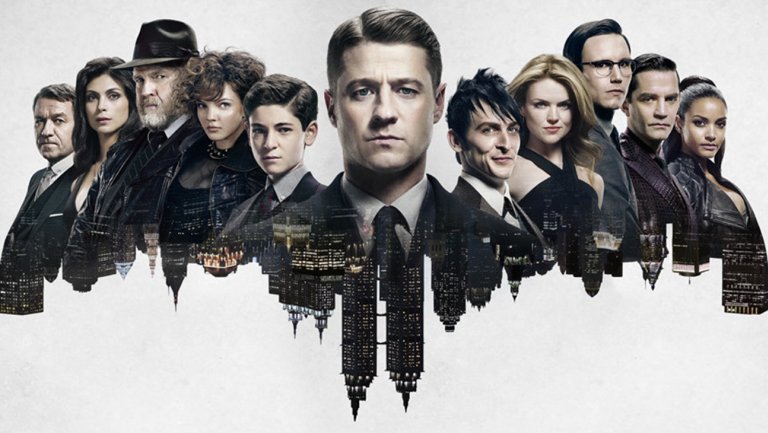
Gotham on FOX

This use of characters as the connection between media outlets has its pros and cons. One con is that it narrows the selection a viewer has if they like a specific story. They don’t even have the pros of multimedia when choosing. For example, if someone likes DC’s tv series Gotham on FOX, they are only able to watch it there, and because it is in its own story (meaning not connected to the other TV shows) it is Gotham on FOX or nothing. Conversely with the films, if you like the story, then the films are your only way to follow it because they do not bleed into the shows or comics. However, it is not all bad. Using characters as connections instead of a universal story is not as alienating as one may think. Fans of Superman or Batman now have many different takes on their favorite heroes, instead of just one version through out. If I do not like how Batman is being portrayed in the films, I can just read the comics. Another plus is that if the films start to go in a direction one might dislike, then they can watch the television shows or read the comics, which are not bound by the story lines of the films. 

Don't worry DC lovers, you have alternatives.

What DC has done in their use of media is unique. As a whole, it is not doubt transmedia, but once one looks closer, they will start to notice that things get very specific. This seems to be negating what transmedia is trying to do by allowing multiple access points, but because the universal connection between the media is characters rather than just one world, it still keeps things open. It is both transmedia and singular media at the same time. It is hybrid media.

BIBLIOGRAPHY:
Image 1 - http://www.popoptiq.com/admirals-jedi-aliens-ten-notable-characters-star-wars-expanded-universe/
Image 2 - http://www.comicbookmovie.com/fansites/rorschachsrants/news/?a=22894
Image 3 - http://wordballoon.blogspot.com/2011/09/take-dc-comics-nielsen-survey.html
Image 4 - http://www.hollywoodreporter.com/live-feed/first-look-gothams-season-2-813290
Image 5 - http://www.forbes.com/forbes/welcome/
One 3 Productions, "Transmedia 101 by One 3 Productions" YouTube video