Wednesday, September 23, 2015

The Society of the Cell Phone


The society of the spectacle cannot be easily defined since it is not technically a physical thing but rather an idea. Earlier on in his book Guy Debord says flat out “The spectacle is not a collection of images; rather, it is a social relationship between people that is mediated by images”(Debord 4). So what exactly does that mean? Well rather than being an advertisement on a billboard or a blockbuster movie, the spectacle is the response people have to those pieces of media with other people. So for example the song "The Macarena" is not a spectacle but the response and craze that swept the nation that found everybody dancing and using it in common lexicon is. One thing Debord says which I think is huge and couldn’t be more right is “The spectacle is the stage at which the commodity has succeeded in totally colonizing social life”(Debord 42) Debord is saying a couple of things here. First you have to understand the role of the commodity in all this. In the Marxist world of Debord, commodity is capitalism and material goods, which is this in not so many words: “In the spectacle’s basic practice of incorporating into itself all the fluid aspects of human activity so as to possess them in a congealed form, and of inverting living values into purely abstract values, we recognize our old enemy, the commodity.” (Debord 35) So going back to the previous point, the commodity totally colonizes social life. It’s as if our lives are taken over and changed forever by this so-called spectacle. A great example is the phenomenon of “the selfie.”
Attractive Woman Taking a Selfie.
Image by Doris Cacoilo

 It almost happened overnight but somehow every person in America is obsessed with taking pictures of themselves, and “the establishment” is taking advantage of it. I hate to say it but the selfie movement has taken over  and like Debord says this take over is done with such fluidity and ease no one seems to notice nor can they get away from it. For me it’s extremely difficult to read Debord without thinking about social media and today’s society that has revolved around “tweeting” and “texting” and being attached to a cellphone 24/7 turning in to a bunch of zombies on cellphones. 
America's Zombies  Image by CSglobe  

Somehow Debord saw the future and knew what was to come. Chapter 2 of the text has a great op-ed piece called “Text Messaging and the Thumb Tribe” In this piece they talk about the rise of text messaging in the world and how it became adopted  as a sociocultural way of life.While texting has brought some positive change to the world there are also many problems "Of Course, with the rise in popularity of texting comes a range of unintended problems and issues. One such issue is texting while driving, which greatly increases the risks of accidents...Sexting or sending pornographic pictures or comments, has also become an issue" (Pavlik 43) Debord was right on the money way back in 1967 and knew exactly what was on the way. “Cell phone use and social attitudes, or the amount of time people spend on the internet (or facebook), and deteriorating social skills.”(Pavlik 43) Without meaning to get too dark, it makes complete sense why Debord would take his own life in the mid 90’s. The world was changing and he knew he couldn’t stop it.  


Notes:
1, Debord, Guy. "The Society of the Spectacle." (2) (Debord). 1967. Web. 24 Sept. 2015. <http://www.bopsecrets.org/SI/debord/2.htm>

2. Pavlik, John V., and Shawn McIntosh. Converging Media: A New Introduction to Mass Communication. 3rd ed. New York: Oxford UP, 2014. Print.
Jeremy Olshvang
9/23/15
Society of the spectacle post
            The society of the spectacle refers to the idea that human beings as a species are mesmerized and enamored by the ever-expanding media landscape that dominates our lives through its omnipresence. What this means is that the media, in its various forms and outlets, affects us by controlling what we are exposed to on a daily basis and persuading us to behave in certain ways. From the clothes we wear to the news we read, the spectacle is constantly influencing us in ways we might not even realize because we have become so immersed in it. The way Debord describes the spectacle is actually in terms of its own impact. This is apparent when he says, “In the spectacle’s basic practice of incorporating into itself all the fluid aspects of human activity so as to possess them in a congealed form, and of inverting living values into purely abstract values…” (Debord, 35). Debord is speaking to the idea that the spectacle is media that manages to integrate itself into all facets of our lives in an attempt to control our thoughts, opinions, and actions. Therefore, it is called a spectacle because it dominates all that we see. However, to just say that the spectacle is the media without knowing exactly what the media is can be too vague of a definition. In his book “Convergence Culture: Where Old and New Media Collide,” Henry Jenkins defines media through a model provided by a historian named Lisa Gitelman in which media “…works on two levels: on the first, a medium is a technology that enables communication; on the second, a medium is a set of associated ‘protocols’ or social and culture practices that have grown up around that technology” (Jenkins, 13-14). Jenkins’ definition of media as the technology we use to communicate as well as the opinions, behaviors, and mannerisms that form as effects of that technology and communication helps to further illustrate the power of Debord’s idea of the spectacle and its effect on society.
A modern day example of Debord’s spectacle would be the influence that the social media application Instagram has had on society. On its surface level, Instagram is merely an application that enables users to share photos with one another. However, because of the power of the spectacle Instagram is more widely known for the culture it has created around itself and now promotes. A form of social media intended for sharing photos has become synonymous with superficiality and fakeness. One would think this would deter people from using it yet the society of the spectacle has become so engrossed by its culture because we tend not to realize it or are just trying to keep with the status quo. Perhaps the biggest reason we as people continue to behave in this manner is due to the impact of what Debord refers to as the commodity. Debord describes the commodity as “the domination of society by “imperceptible as well as perceptible things” (Debord, 36). Sticking with the example of Instagram, we as people are dominated by yet captivated with images on social media that are real in the general sense, but so heavily edited or taken out of context in ways that many times go over our heads. This is why the commodity, as Debord goes on to say, “attains its ultimate fulfillment in the spectacle, where the perceptible world is replaced by a selection of images which is projected above it, yet which at the same time succeeds in making itself regarded as the perceptible par excellence” (Debord, 36). Commodities are created in the spectacle because we as people are many times deceived into substituting real, attainable thoughts, actions, and goals with delusions of grandeur. Eventually, after enough human exposure to commodities they themselves become the spectacle. Debord describes this process when he says, “The spectacle is the stage at which the commodity has succeeded in totally colonizing social life. Commodification is not only visible, we no longer see anything else; the world we see is the world of the commodity” (Debord, 42). Once a commodity has become so immersed in our culture to the point where it feels as though it has become a part of our everyday lives, it has become the spectacle. It is all we see and we do not question it, we just go along with it because we feel like we have to in order to keep up with everyone else. However, what we take for granted is that in doing so, we not only are willingly allowing ourselves to be controlled, but we are giving up our individuality.

Cartoon depicting how our needs as a society have shifted as a result of the spectacle
Picture depicting how the spectacle has captivated us entirely as a species

Bibliography

Jenkins, Henry. Convergence Culture: Where Old and New Media Collide. New York: New York UP, 2008. Print.

"The Society of the Spectacle." (2) (Debord). N.p., n.d. Web. 01 Oct. 2015.


Post #1: Society of the Spectacle [Ali Ismail]

Ali Ismail
Convergence
9-23-15

You hear of a spectacle and you can't help but feel curious. Hearing the word means that something big and grand that is not of normal occurance is happening right in front of the eyes of a select people witnessing it, and those people hold an experience that no one else can empathize with. It is a visual experience that with the help of technology such as social media and smartphones, is now everywhere when only a few years ago they were nowhere. Debord in her book Society of the Spectacle makes a similar point when she mentions Television as like the smartphones of today, television was an invention that was nowhere, and then suddenly everywhere. Television began to emerge in family households during the 1950s of America which was right after the victory of World War 2 and the rise of Consumerism. The 50s were known as a very happy time where everybody had to buy buy buy to assure their social status and have a happy life. This is part of what Debord speaks about in Chapter 2 of her book The Society of the Spectacle, only she is referring to Television in her example. This idea however correlates to the idea of the Smartphone, or more specifically social media culture in which both were nowhere, but in a short time less than a decade were suddenly everywhere. Even old people who didn't know or didn't want to know about social media knew about its existence. 10 years ago I could only think of Myspace as the first big boom of social media on a wide level. Before that would be small clusters of people on message boards or forums, but nowhere near the level of today's Twitter, Instagram, and Facebook. However in this chapter Debord never explicitly states what the Society of the Spectacle is. The Society of the Spectacle refers to the fact that these Spectacles are now at a level worldwide and can be viewed by anybody. An entire society of people on this planet can now not only view the spectacle or any spectacle that emerges no matter how small it starts, but anyone in a moment's notice in less than a day become the spectacle, in some cases without trying to be one.

There are two examples, one recent and one about a year ago, of ordinary people who in a very short time suddenly became a spectacle and were known by nearly everybody. One of those examples is the once very sudden popularity of "Alex From Target" which happened about a year ago from today.

A picture of a boy named Alex who went from working a regular job at Target to suddenly being on the Ellen show and
receiving mass recognition in  a very short amount of time.
Taken from this website
Alex from Target is the epitome of somebody who represents The Society of the Spectacle and how it can turn a very ordinary person into someone who has the eyes and admiration of millions of people. The story of how he became to be couldn't be more simple or basic. According to this article, Alex from Target was a silly joke a few people made on Twitter as part of an injoke. With these social media sites, it's easier for us to hop into the latest fades by simply browsing, hearing it from our friends through sharing and retweets, or by using the ever popular hashtag, and it makes us feel like we are a part of something greater. It's why we have hipsters who boldly claimed "Yea I liked it before it was popular!" All of a sudden in one day which even stuns the writer of the article, Alex from Target turns from an average student working a low income job into a celebrity who appeared on numerous Vines from top Viners as well as appearing on the Ellen show. The fact that this was possible almost sounds stupid, and saying it outloud doesn't make much more sense. However because our society is not only able to witness any spectacle, but has the power to MAKE anything a spectacle, this average joe now is living in fame and fortune for doing absolutely nothing but embracing the spotlight and becoming a spectacle, even if he didn't know he would become one.

A more recent incident of this happening is to a young boy named Ahmed Mohamed. 

A picture of Ahmed Mohamed taken after he was arrested for bringing a homemade clock to school and invited to the White House shortly after.

Taken from this website


Ahmed Mohamed is a 14 year old boy who was arrested for bringing a homemade clock that the authorities mistook as a bomb. While I won't expand upon this fact in detail, it's very hard to make a case that this isn't a racial profiling case. His name "Ahmed Mohamed" screams to authorities he's a Muslim and thus the negative connotations that grew stronger against the Middle East after 9/11. It's like if a Christian boy was named "Jesus Joseph". This kid was going to be psychologically traumatized and ruined for the rest of his life for a crime he didn't commit because of his race. However when news spread quickly of what had happened to him, the Society of the Spectacle quickly spread word of his condition and in less than 24 hours the President of the United States, Barack Obama, responded that the watch was cool and he should bring it to the White House. In a day what would've been a horrible turning point for this child's life suddenly became one full of hope and happiness. Had this happened 10 or so years ago, this would not have happened and this child would be having a very dark life in a prison cell.

As we discussed in class and as written in the Chapter, the Society of the Spectacle surrounds all of us and is in our everyday lives. However the spectacle is more than just what we consume. In the world we live in today, anything or anyone can become a spectacle. Even on the first day of class when the Professor mentioned Rudy Mancuso, he is a fine example of a student quickly rising in popularity on a social media platform (Vine) and has his life transformed into a literal spectacle. For Rudy 2 or 3 years ago he was just like all of us worried [or slacking] on the next homework assignment due and with the usual stress/life of a college student. Now that's all in the back of his mind and he's living a good life being a superstar on Vine. The idea of a spectacle of life is something that happened decades ago with Television as Debord makes mention of in her book, and will continue to exist through different platforms even in the future.


                                                                            Works Cited


Classroom discussion. Convergence. Doris Cacoilo September 17th 2015.
Debord, Guy. "Chapter 2: The Commodity as Spectacle." Society of the Spectacle. Detroit: Black and Red, 1977. N. pag. Print.
"Who Is 'Alex From Target' and Why Did the Internet Make Him Famous." Time. Time, n.d. Web. 20 Sept. 2015.

Dylan Parlow Blog Post #1


      The Shift of Economy and Culture in the 20th Century     

            As the economy of western nations developed from labor-based to consumer-based, came the emergence of the spectacle that Guy Debord describes in The Society of the Spectacle.  The spectacle came to fruition with the development and commercialization of mass media. The commodity and the spectacle have converged with one another since the development of our now consumer-based economy.
            To Debord, the society of the spectacle began with the development of the moving image. These moving images entranced the public eye as they, in a way, created the reification of events and news stories that the public was mostly only able to read about in the papers.
            Since the moving image went from having a niche audience to a mass audience in the span of a couple of decades, society embraced this new technology and changed along with it at a very rapid pace. The actors projected on these giant movie screens became celebrities after the public demanded to know their real identities. The public idolized these charismatic individuals and wanted to be just like them. Clothing and accessories became a way for the masses to emulate these stars while also expressing their individual personalities to everyone around them, and so consumerism was born. 
Florence Lawrence, the first movie star
            Debord believes that “the spectacle is the stage at which the commodity has succeeded in totally colonizing social life… the world we see is the world of the commodity” (Debord 42). The commodities of today are the objects we feel we need, that we can’t live without. As Cold Stone Creamery puts it via the names of their serving portions; Like It, Love It, and Gotta Have It! These products indicate our social status and define how cool and hip we are. If you’re left behind there can be real consequences.
On a recent episode of Slate’s podcast Double X, staff writer Amanda Hess stated, “teenagers who don’t have cellphones [about 15% of U.S. teens] see their friends in person less frequently than teenagers who do have cellphones or smartphones.” This statistic shows how the commodity can have a genuine effect on people’s social lives, because they have not kept up with the social norm of owning a cellphone they are now unable to communicate with their friends outside of school, work, etc. and thus get left behind socially in the process.
It’s not just the social sphere that Debord accurately predicted the spectacle would effect either, it now includes the transformation of journalism to emphasize quantity over quality. This transformation of “the loss of quality that is so evident at every level of spectacular language… can [now] develop only within the quantitative” (Debord 38). The number of stories published in a physical newspaper is limited by the size of the publication. As Clay Shirky describes in Everyone Is A Media Outlet, “what doesn’t get into a newspaper is whatever is too expensive to print and deliver,” but with the development of online and citizen journalism came the “switch from “Why publish this?”” to “Why not publish this?”” (Shirky 60). We are now overflowing with information and the mass media has adapted to this change by focusing on breaking news updates on their websites and social media accounts. Our Twitter feeds need to be refreshed every minute to keep up with all of the new tweets that are being sent out by those we follow.
The commodity is the spectacle because it follows us everywhere we go. In the social sphere our friends and peers talk about current events, music, movies, etc. At home in the private sphere  advertisements, movies, and TV shows bombard us on our sleek, aesthetically pleasing computers and 50" HDTVs. We need commodities to stay relevant because if we aren't relevant or "in the know" then we fear that we will be perceived by society as out of touch and obsolete.
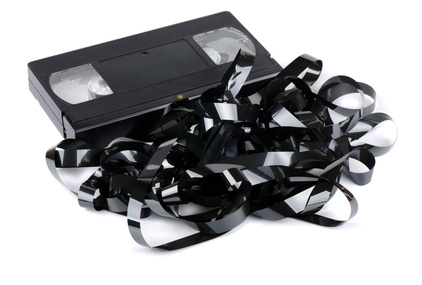
RIP VHS: (1970-2008). All innovations will soon be primitive.
Bibliography:

1. Thomas, June. "Double X: The Text Me You Love Me Edition." Interview by Amanda Hess. Audio blog post. Slate.com. Slate, Aug.-Sept. 2015. Web. <http://www.slate.com/articles/podcasts/doublex_gabfest/2015/09/mass_incarceration_internet_isolation_and_personal_essay_addiction_on_this.html>. 

2. Debord, Guy. "Society of the Spectacle." The Society of the Spectacle. New York: Zone, 1994. N.   pag. Print. 

3. Shirky, Clay. "Everyone Is A Media Outlet." Here Comes Everybody: The Power of Organizing without Organizations. New York: Penguin, 2008. N. pag. Print.
Greg Clayton
Convergence Blog #1
9/23/15
            The society of the spectacle is Debord’s rhetoric of calling an open and free market exchange of goods and services detrimental to the overall good of society because we will all become slaves to our possessions and greed.  That society as a whole will cease to function, and people will be so caught up in their own vanity of wealth, that basic human necessities and the need to coexist will be swallowed up by the spectacle of commodity.  How’s his prediction so far?  Yes, some people can get caught up in the spectacle, if you let it.  But what Debord fails to recognize is that not all people who seek success or certain material possessions are inherently bad or corrupt.  Some people work hard for what they have, and do not necessarily partake in the spectacle, but rather carve out a nice life for themselves and stand in the shadows of the spectacle, but are included in Debord’s generalizations.  Why does society need to answer to Debord because they buy unnecessary material items? If he does not like the “spectacle” than why is he throwing his hat into the ring and being part of it?  He publishes books, he makes films.  To me, someone who is fed up with a society that makes a “spectacle” of itself and then gains from that opinion is a hypocrite. In quote 35 Debord says “…we recognize our old enemy the commodity, which at first glance so trivial and obvious, yet which is actually so complex and full of metaphysical subtleties.” (Debord Chapter 2, 35).  It’s almost comical to call commodity “our old enemy” because it is as natural as nature itself.  Debord’s world is delusional at best, sorry metaphysical. 

            Commodity isn’t the spectacle, it is the absence of basic human decency and the ability to better the world around people who have been given or earned said commodity.  The spectacle is the Paris Hilton’s of the world, not the Warren Buffet’s or Bill Gates’.  In an article by Anselm Jappe posted by Alias Recluse on libcom.org, Mr. Jappe contends, “The commodity and its general form, money, might have served a positive function at first, facilitating the expansion of needs. But its structure is like a time bomb, a virus inscribed in the genetic code of modern society. The more the commodity seizes control of society, the more it undermines the foundations of society itself, rendering it entirely uncontrollable and transforming it into a self-operating machine. It is thus not a question of praising or condemning the commodity; it is the commodity itself which will get rid of itself over the long term, and maybe not just itself. The commodity inexorably destroys the society of the commodity. As a form of indirect and unconscious socialization, it cannot but produce disasters” (Jappe 1993).  That was in1993. Debord’s realizations and predictions were in the 60’s.  When are these going to come to fruition?


Debord's 21st Century Spectacle

Renee Curva
Convergence
Society of the Spectacle Post
23 September 2015

Throughout history, the progression of technology spurred the creation of media and provided a vehicle for the ominous spectacle. The society of the spectacle can be known as the universal audience that is effected by, and may participate in, numerous forms of mass media. From the penny press, telegrams, to the radio, New York Times, and Twitter, the need for communication within society has never dwindled. In the 21st century, the ‘bigger’ society of the spectacle is almost anyone with a smartphone or access to the internet, television, and/or written word.
Debord describes the spectacle and its impact by noting the fetishism found within society for projected images. Forms of the spectacle such as the television and movie theater, transformed the society into something that finds completion in images and things. Perceptible things such as a new purse featured in magazine ads and imperceptible things are all advertised by the spectacle. “The spectacle is a permanent opium war designed to force people to equate goods with commodities...”(Debord,36). Debord explains that by taking part in an economy that was shaped by the spectacle, the consumer themselves gives into the “modern complement of money” (Debord, 49). For example, if a certain make up product is featured on Kylie Jenner’s Instagram page, the spectacle (in the form of social media) entices the mass public to purchase a certain product being marketed by Jenner. This example is just one of many, showing how society has imprinted on the spectacle.
In The Society of the Spectacle, Debord explains the theme of commodity through the transformation of the economy. He elaborates on a ‘commodity economy,’ a fiscal power house that was jump started by society’s fetish for the spectacle. “With the Industrial Revolution’s manufactural division of labor and mass production for a global market, the commodity…was colonizing all social life” (Debord, 41). Because of the spectacle, Debord argues that a significant amount of social status is placed on the commodity by the public.
The work force and capitalist economy have created a new thirst among the public. Debord noted, “the vast majority of people are still forced to take part as wage workers in the unending pursuit of the system’s ends…”(Debord, 47). Women’s magazines are a perfect example of the constant development of commodity as spectacle. Each month’s issue of a fashion magazine will feature new clothes, trends, and products. A working woman who follows these magazines and gives in to the commodities, prides herself on being current and holds herself to the same level of said fashion magazine. The same can even be said about the amount of importance put on upgrading to the newest edition of an iPhone. This shows the socioculture factors placed on commodities. The people work to spend money and participate in the spectacle, giving power to the commodity and creating a new need for survival. Debord explains the reciprocal relationship between commodity and spectacle by saying, “The real consumer has become a consumer of illusions. The commodity is the materialized illusion and the spectacle is its general expression”(Debord,47).  Society will always be hungry and willing to spend money on the commodity, further reinforcing the spectacle.

This picture depict's society's fetishism for projected images through technology. Increasingly, over the years of the smartphone, people have been more attuned to their cell phones rather than with the company of other people. 


This picture depicts the commodity as a materialized illusion. The  cut out Barbie eyes are used to satirize society's beauty standards. Cosmetic procedures, as exemplified by pop culture icons such as the Kardashians, are a materialized illusion marketed through the spectacle. 

Bibliography:
Debord, Guy-Ernest. "The Society of the Spectacle." The Situationist International Text Library. N.p., 1967. Web. 30 Sept. 2015.

Barbara Cummings
Convergence
September 23, 2015/Society of the Spectacle
Society of the Spectacle in analogy how the world is taken in by the fundamental nature of knowledge  by a theorist  who opens up a whole reality  of what is known as the speckle.  Guy Debord recounts how the earth has been taken by the unknown. We have in quote “Marx's theory of alienation, the spectacle describes our passive, quasi-visual relation to the social world”. (Kaplan, RL) We want what we don’t have and once we have it we want more. Vanity pure vanity.  For example, there are  video games, various types of music TV and social networks which keep one on the edge to now miss out on the next upcoming trend. Debord states that "the spectacle presents itself simultaneously as society, itself as part of society, and as means of unification. (1) We feel united or powerful or in turn with the universe when it comes to the spectacle. Debord describes the spectacle and its impact as to say one cannot escape the spectacle. It’s everywhere,  I think about how Henry Jenkins quote” said media is an ongoing process occurring in various intersections of media and technology content industries and audience.
https://szeying91.wordpress.com/2012/09/20/media-convergence
So there how can you avoid the spectacle is haunts you. You may feel like you don’t need it or it isn’t important, but fact of the matter is, when you ignore what is right in front of you. The spectacle will make you feel a great amount of dissatisfaction.  The commodity as the spectacle is a distorted depiction of what one thing is real, for example the latest trend in technology, i-phone video game or social media outlets. You state “I Don't need it! True, but the spectacle will make you feel like you're missing out, only because you just got the last iphone. There you go, media, communication  the newest technology.  
janet-jackson-to-release-new-album-2015-2.jpg (1280×960)
http://www.liveleft.com/wp-content/uploads/2015/06/janet-jackson-to-release-new-album-2015-2.jpg
No one can escape it. Your adrenaline runs and you start to feel the  void. Here comes the spectacle trying to soothing your soul. We become delusional about the latest fad, car, trend of clothes houses, places to venture to live. The majority of people today are won over by what the world says what will bring true happiness.  Debord writes about how "behind the masks of total choice, different forms of the same alienation confront each other"(1). We hear and think yes the  think of the collaboration of face-book, g-mail, video, i-tunes, the internet in general. We communicate our ideas or just make someone buy into our idea of the next best thing, we become the  spectacle or what we want it to be. TV, electronics help us sell the idea. Debord states” The domination of society by “imperceptible as well as the perceptible things”- attain its ultimate fulfillment in the spectacle, where the perceptible world is replace by a selection of image which is project above it, yet which at the same time succeeds in make itself regard as the perceptible par excellence.  The mind make one feel  invisible, entity and if we have it we are  to waste. We think if we have the specialty we have arrived and are brilliant.  So as we pondering on the unknown the spectacle help us to believe through media, technology and the truth of the unknown to be true.  We live in a superficial society the world of the spectacle the world of the unknown, the world of make believe, a material world.
Work cited

  1. "The Society of the Spectacle by Guy Debord." The Anarchist Library | An Archive of Anarchist Literature. N.p., n.d. Web. 23 Sept. 2015.
  2. Kaplan, RL. "Between Mass Society And Revolutionary Praxis: The Contradictions Of Guy Debord's Society Of The Spectacle."European Journal Of Cultural Studies 15.4 (n.d.): 457-478. Arts & Humanities Citation Index. Web. 23 Sept. 2015.
  3. Debord, Guy. The Society of the Spectacle. New York: Zone, 1994. Print.