Thursday, November 19, 2015

Barbara Cummings
Convergence
11/18/15
Multimedia and transmedia uses different strategies to attract their audience. They both have distinct  plan of action to capture various platforms to expand the reach and experience of a story  from two contrasting  approaches.  My subject matter will be Avatar in which has various platforms including  games, social media, traditional media, and movie forms.  There seems to be a myth according to Henry Jenkins’s as to ”transmedia storytelling refers to any strategy involving more than one media platform.” (2) “He also states that Transmedia storytelling represents a process where integral elements of a fiction get dispersed systematically across multiple delivery channels for the purpose of creating a unified and coordinated entertainment experience.” (2)


In transmedia there have been industry mergers with technological transformations with the rise of giant new digital media players and transmedia storytelling for instance the sidekick “droids” R2-D2 and C-3PO from the original Star Wars trilogy (1977–83). Lucasfilm—20th Century Fox/The Kobal Collection. One way that transmedia has engaged with media convergence is through storytelling, in which stories are told across diverse aims. There are an enormous amount of trademark franchises  such  star wars, and some of Disney franchises does not simply refer to the adaptation of content from one platform to another (e.g., films and film characters providing the basis for toys and games). (4) However we must understand that  that all media franchise that has become totally transmedia-oriented; all have had a primary source for the narrative, such as a film, television show, or book of some sort.

www.google.com/search?q=sidekick+“droids”+R2-D2+and+C-3PO+from+the+original+Star+Wars+trilogy+(1977–83).+Lucasfilm—20th+Century+Fox/The+Kobal+Collection&rlz=1CAACAC_enUS568US568&source=lnms&tbm=isch&sa=X&ved=0CAcQ_AUoAWoVChMI_fbbysebyQIVSGw-Ch31IwMV&biw=1319&bih=704#imgrc=
http://imaginarycinema.com/starwars_se.html


It depends on the approach to define transmedia and the way you interpret its a story storytelling. Carlos Scolari has observed, transmedia storytelling “is a particular narrative structure that expands through both different languages (verbal, iconic, etc.) and media (cinema, comics, television, video games, etc.).” (1)As I stated above as to  transmedia storytelling can be a resource of companies  brand extension for media corporations, and hence further revenues and profits from reaching new audiences and selling more products, it has also functioned as a form of fan engagement with particular media content as they put together a richer and more complex narrative around it. Transmedia storytelling has predated through the Internet, the power of media convergence has greatly extended its possibilities to its audience who will see out their desired across and media platform.
For instance, “the British television series Doctor Who had been the subject of various loose, but “unofficial,” forms of brand extension (comics, novels, records) as early as the 1960s, and fans had long engaged one another in producing “fictional worlds” around the television show.” By 2005 the arrival of media convergence  Doctor Who after 16 years was  off the air, the new series had an straightforward  transmedia format, with such material as specially produced short online episodes, internet outlets within the Doctor Who world, and podcast commentaries on the televised episodes. Doctor who transmedia format leave one to agree with Jenkins as he stated  that “most media franchises, however, are governed not by co-creation (which involves conceiving the property in transmedia terms from the outset) but rather licensing (where the story originates in one media and subsequent media remain subordinate to the original master text.)”.
https://youtu.be/0csVdLbDMO4
In contrast in definitions the term multimedia it is a single story that is told concurrently via different media, with the core narrative being supported by artifacts spread out across many types of media. (Jenkins) So not one single article may tell a complete story by itself it would always be a narrations in conjunctions in the absence of the elements. So there will be a range of ARGs labeled as transmedia actually seem to be multimedia.  so you really will have to consider many a traditional merchandising  to be a form of transmedia storytelling, but I doubt it can be classified even as multimedia.  

ttps://themediajungle.files.wordpress.com/2011/02/avatar-movie-navi-neytiri-2.jpg?w=625

So in a sense in regards to multimedia avatar is often a fantasy figure or animal chosen by the player. We think about the movie Avatar, it was not  just the animated figures that populate our screens but the gestalt of images, text, and multimedia that make up our online identities--in virtual worlds like Second Life and in the form of email, video chat, and other digital artifacts. Exploring such network activities as embodiment, extreme (virtual) violence, and the work in virtual reality labs, and offering sidebar interviews with designers and practitioners, she argues that what is new is real-time collaboration and co presence, the way we make connections using networked media and the cultures we have created around this. (4)

http://www.ew.com/sites/default/files/1447192067/avatar-01.jpg
To sum up the difference in multimedia and transmedia we see both as an having the source of media convergence: phenomenon involving the interconnection of information and communications technologies, computer networks, and media content. Avatar the Hollywood’s Manhattan Project and even before Avatar we had  Star Wars was marked Hollywood’s new approach. Key elements included merchandising tie-ins, high potential for international distribution, new technologies (digital animation, special effects, computer-based film-editing). As to transmedia is a rapid form of communication in which stories are told across multiple media.  (4)
Work Cited


1-Flew, Terry. "Media convergence." Encyclopædia Britannica (September 2014): Research Starters, EBSCOhost (accessed November 16, 2015).
2. Jenkins, Henry. "Transmedia Storytelling 101." Confessions of an AcaFan. Web. 17 Nov. 2015.
3-Jenkins, Henry. Convergence Culture: Where Old and New Media Collide. New York: New York UP, 2006. Print.
4-Lili Teng, Foti, and Hannafin Robert D. "Games And Multimedia In Foreign Language Learning -Using Back-Story In Multimedia And Avatar-Based Games To Engage Foreign Language Learners: A Pilot Study." International Journal Of Emerging Technologies In Learning 3 (2008): 40. Directory of Open Access Journals. Web. 17 Nov. 2015.

Wednesday, November 18, 2015

The Era of Transmedia (Where Stories Never Die)

        When you finally hit the last page of a book series that has greatly impacted your life or have finally reached those last credit scenes of a TV series you have been watching on Netflix, one question usually passes through your mind. Is this it? With some stories within media, the answer is a heart-breaking “yes” and fans have to stick to their own imaginations to continue the stories or watch reruns from the very beginning again. Other stories within media have been more lucky with this question. With the help of “transmedia”, stories are no longer bound to the pages they were first written on. It now lives on through various platforms.
Marvel Comics compared to Marvel Films
Characters
        In definition, “transmedia” is the technique of telling a single story or story experience across multiple platforms and formats including, but not limited to games, books, events, film and television. It is a concept that first came into light through the works of Henry Jenkins; first featured through his seminal book Convergence Culture. In his book Jenkins states, “In the ideal form of transmedia storytelling, each medium does what it does best—so that a story might be introduced in a film, expanded through television, novels, and comics; its world might be explored through game play or experienced as an amusement park attraction” (Jenkins 98). With this said, Jenkins explains transmedia to start as one form of media while expanding its storytelling through other forms of media. This is an entirely different concept to another term that features similar concepts of media; the term known as “multimedia”. 
         Multimedia, in contrast, refers to content that uses a combination of different mediums. Stories within the media can use multimedia to reiterate its already made concepts, without changing the storyline. Films can provide books, comics, or even products that follow the same storyline, but it does not expand what is already made in the story. For example, Marvel comics such as Stan Lee's The Amazing Spiderman and The Avengers have their stories retold in the form of films and television shows. In this, their story-lines do not change, but their medium does from comic books to the big screen. This is what makes multimedia and transmedia so significantly different. Multimedia sticks to the same story, but multiplies its story through various forms of content. Transmedia similarly tells stories through various mediums, but it uses the various mediums to expand the story even more. 
Film Director Joss Whedon
         Writers, filmmakers, and other artists have used transmedia to further their stories through various media platforms. One of the most well-known filmmakers that has done this is Joss Whedon. Whedon has been known to create cult classics and expand his sci-fi and fantastical worlds, most of his fans refer to as the “Whedonverse”, through many forms of media (PopMatters). This can be seen through his work with cult television show Buffy the Vampire (1997-2003) Slayer and more recently Marvel’s The Avengers (2012) and his works to expand the Marvel TV/film universe through the television show Marvel’s Agents of Shield (2013- ), which he produced. Even with all these great examples of Whedon’s transmedia works, Whedon’s greatest example of transmedia taking a story and keeping it alive can be shown through his cult TV series called Firefly (2002-2003).
       
Firefly TV Series (2002-2003)
 The Firefly series was a very short-lived one. The show first appeared in late 2002 and was already gaining an interested audience. Even for this, the executives of the Fox Channel saw past the show’s growing audience and decided to cancel the show because of low viewership (Hadlock, "Done the Impossible: The Fans' Tale of 'Firefly' and ‘Serenity'"). Whedon and his Firefly crew as well as most of the fans believed that this was the end for the short-lived western sci-fi series with only 13 episodes to be known for. They were proven wrong when the fans fought hard to give Firefly another chance that many believed it greatly deserved. The issue was that Fox was not looking to renew the show anytime soon, so what was the series to do? Can Firefly continue its story with all these complications brought forth by television?
          As Joss Whedon became more well-known, he was able to expand the story without renewing the series. Transmedia made it possible for Whedon to expand the story of Firefly on the big screen two years after its television cancellation through the film Serenity (2005). Whedon was able to pick up the story from where the series left off and continue the adventures to Captain Malcolm Reynolds and his crew of “Big Damn Heroes” through another medium ("How Transmedia Brought Firefly Back to Life”). This installment in the Firefly storyline excited its fans. The story they had fought to renew had now been brought back to life through another form of media and had taught them an important lesson about transmedia; no longer will their stories be silenced by television executives (Hadlock, "Done the Impossible: The Fans' Tale of 'Firefly' and ‘Serenity'"). 
Firefly TV Series (2002-2003)
Serenity film (2005)
Serenity Comics (2013)
Cast of Firefly in New York Comic Con Panel (2015)
         The story of Firefly does not stop at the end of Serenity’s ending credits. The fans wanted so much for the story to go on that Whedon decided to continue the story through even more mediums. A series that started in 2002 and was supposed to have ended is still alive and expanding through other forms of media. In 2013, Dark Horse comics unveiled a continuation of the Firefly storyline through Zack Whedon’s comic Serenity. The story of Firefly has even expanded outside traditional forms of storytelling.
Done the Impossible:
The Fans' Tale of Firefly and Serenity
(2006)
       Through events such as documentaries and panels in conventions, Whedon and the crew of Firefly are able to expand the story in a more formal and direct setting. In 2015, memebrs of the show reunited for a panel in the New York Comic Convention and even talked about the significance of transmedia on the storytelling of the show. When commenting on the change of media form and the audience's participation in the continuation of the stories within the media, actress Gina Torres states, "I can make something happen. I don't feel like I have to wait to go through this studio system that is so specific--that almost seemed like everest. We have a story we need to tell and we know that you [the fans] are going to be there to support it and support us" (Torres, "Firefly Panel NYCC 2015"). She acknowledges that stories like Firefly can no longer be held back by the traditional issues that most shows, books, movies, etc. have faced in the past and transmedia has made that possible. It gives the fans what they want and lets their favorite stories live on without being bound to any set media platforms. 
Firefly Pilot Episode (TV Series 2002)
           This is what makes the Firefly series such a great example of transmedia. In the words of Jenkins, “A transmedia story unfolds across multiple media platforms, with each new text making a distinctive and valuable contribution to the whole” (Jenkins 97-98). Whedon’s Firefly has done Jenkins’s definition of transmedia justice. It continues its story through multiple forms of media and the story, in the words of Whedon, “keeps flying”. It shows that nothing can stop a story in this era of transmedia; not even certain media platforms. Firefly shows that a story can grow, keep expanding after its set expiration date, and that is can continue to live on for all ages to enjoy for years to come.

Bibliography
Jenkins, Henry. Convergence Culture: Where Old and New Media Collide. New York: New York UP, 2006. Print.
Whedon, Joss. Firefly. 22 Sep. 2002. Television.
Serenity. Dir. Joss Whedon. Universal Studios Home Entertainment, 2005. Film.
Whedon, Joss, and Brett Matthews. Serenity. Milwaukie, Or.: Dark Horse, 2007. Print.
Done the Impossible: The Fans' Tale of 'Firefly' and 'Serenity' Dir. Tony Hadlock. Done The Impossible LLC, 2006. Film.
"How Transmedia Brought Firefly Back to Life." ENGL 359 Transmedia Fiction. 24 Nov. 2013. Web. 17 Nov. 2015.
Torres, Gina, Nathan Fillion, and Jewel Staite. "Firefly Panel NYCC 2015." New York City. 10 Oct. 2015. Lecture.


Daniel Koo

                Multimedia differentiates itself from transmedia in that multimedia encompasses use of multiple forms of media, when it comes to transmedia is storytelling that utilizes multiple platforms. Take for example the now cancelled web series, “My Music,” by the Fine Bros. The show was hosted on their YouTube channel, “Fine Bros. Entertainment,” which is now primarily home to their “React” show. My Music never made it past its second season.


                A quick synopsis on what the premise of, My Music, was. An up and coming company covering mostly music media is run by characters who refer to each other after their favorite genre of music. Indie, founder and CEO, Idol, social media manager, Techno and Dubstep, who book talent, Hip Hop, the head of marketing, etc. The comedy series advertised itself as taking place in a transmedia universe, complete with each character owning their own Facebook and Twitter accounts. The actors were always in character with each post, because although the show was narrative to its viewers, its characters were on a reality documentary show. This style was somewhat similar to the television series Modern Family.

                Transmedia played a large part on the show outside of the regular series. Characters would host news and interview segments known as “The Mosh,” on the YouTube channel. Questions and fan comments would be pulled straight off of the social media platforms they hosted in character, and were responded to in character. Sometimes Facebook and Twitter posts would contain images and screengrabs from episodes that had yet to be released, and would be accompanied by a comment or caption that would read something to the effect of, “I wonder what will happen?” This show is a great example of the utilization of transmedia, because while the show was out, YouTubers, the Fine Bros, had an entire crew working day and night to keep each individual character’s various social media pages updated. Sometimes characters would respond to user comments, and it helped to create a more immersive experience.

Superman (Left) & Batman (Right) (As if you didn't already know...)
                Multimedia is different because it sees one form of art translated into another. Book, to movie, to television series, to comic book, to a comic book that takes place in an alternate reality, and so on. In many cases these translations do not need to relate to one another. For one example, look at DC Comics. The name should be familiar to any and all readers this is the company that gave birth to Batman and Superman in the 1930’s, two characters that have endured to present day. Both Batman and Superman have been the subject of websites, movie franchises, and television series both animated and live action. However, most of these translations of the characters into the varying media
forms have little to no correlation with what came before. They’re all different versions of the same characters that tend to change secondary characters, time periods, and general feel.


                These opposing ends of the spectrum are what make transmedia and multimedia different.

Transmedia Storytelling

Harry Potter & Transmedia Storytelling 

With technology constantly changing and evolving, so are the ways in which people devour culture. Previously, multimedia was the only way to really appreciate and absorb a story. Multimedia is a term used to explain one story told over multiple mediums. However, with multimedia, the story didn’t change when the medium changed, the only true change was the way in which the story was told. Transmedia, as described by Jenkins, is  a story that “unfolds across multiple media platforms, wich each new text making a distinctive and valuable contribution to the whole” (Jenkins, 97). By name alone, transmedia transform a story, it adds something to it and should never feel like a rehash of something already experienced. If anything, transmedia storytelling should work as a companion of sorts.

Using franchise films as an example, The Hunger Games series and its expansion would be the perfect example of multimedia. Though the series started with the books, they were adapted for the screen. However, with that adaptation, the same story was told and nothing was fleshed out beyond what was already given in the book. Though, in an attempt to capitalize on what will be their most successful franchise, Lionsgate is currently looking into other ways they can expand The Hunger Games universe, including theme park experiences. Whether or not the expansion includes transmedia storytelling remains to be seen.
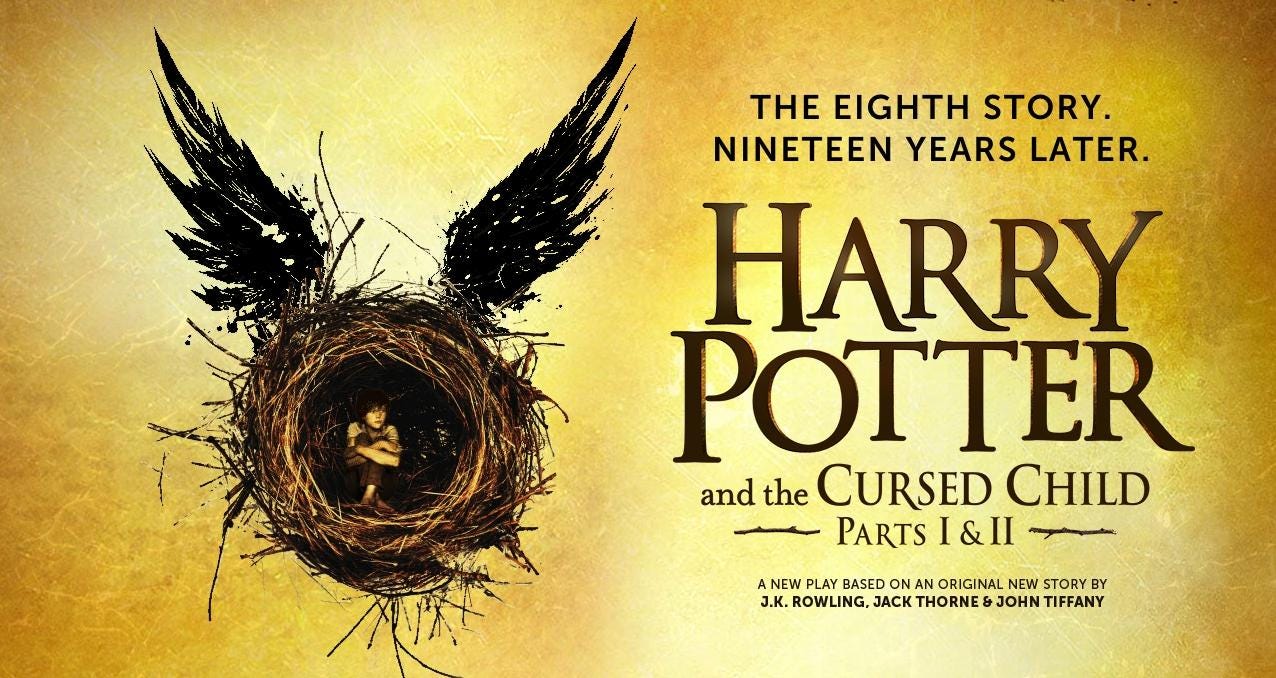
Harry Potter & The Cursed Child Poster (Independent)

To compare, the Harry Potter series is an example of transmedia storytelling, although it started as simply multimedia. After the success of JK Rowling’s books, Warner Bros. optioned the rights for the film adaptations. Though the films were just a version of multimedia, Rowling went on to release more books that took place within the world of the books and told new stories along with giving further information about the characters. One of those books, Fantastic Beasts and Where to Find Them is even getting its own film adaptation, hopefully expanding the Potter-verse even more.

Beyond the books, Rowling manages to keep her story going by sharing information regarding key characters on her own Twitter page. Every so often, Rowling drops tidbits that only serve to enhance one’s reading of the story or viewing of the films. More recently, she announced a Harry Potter play set to open in London next year. The play, titled “Harry Potter and the Cursed Child,” will focus on Potter’s early years, once again adding to the overall experience while expanding the Potter universe to a time before readers even met the boy wizard.

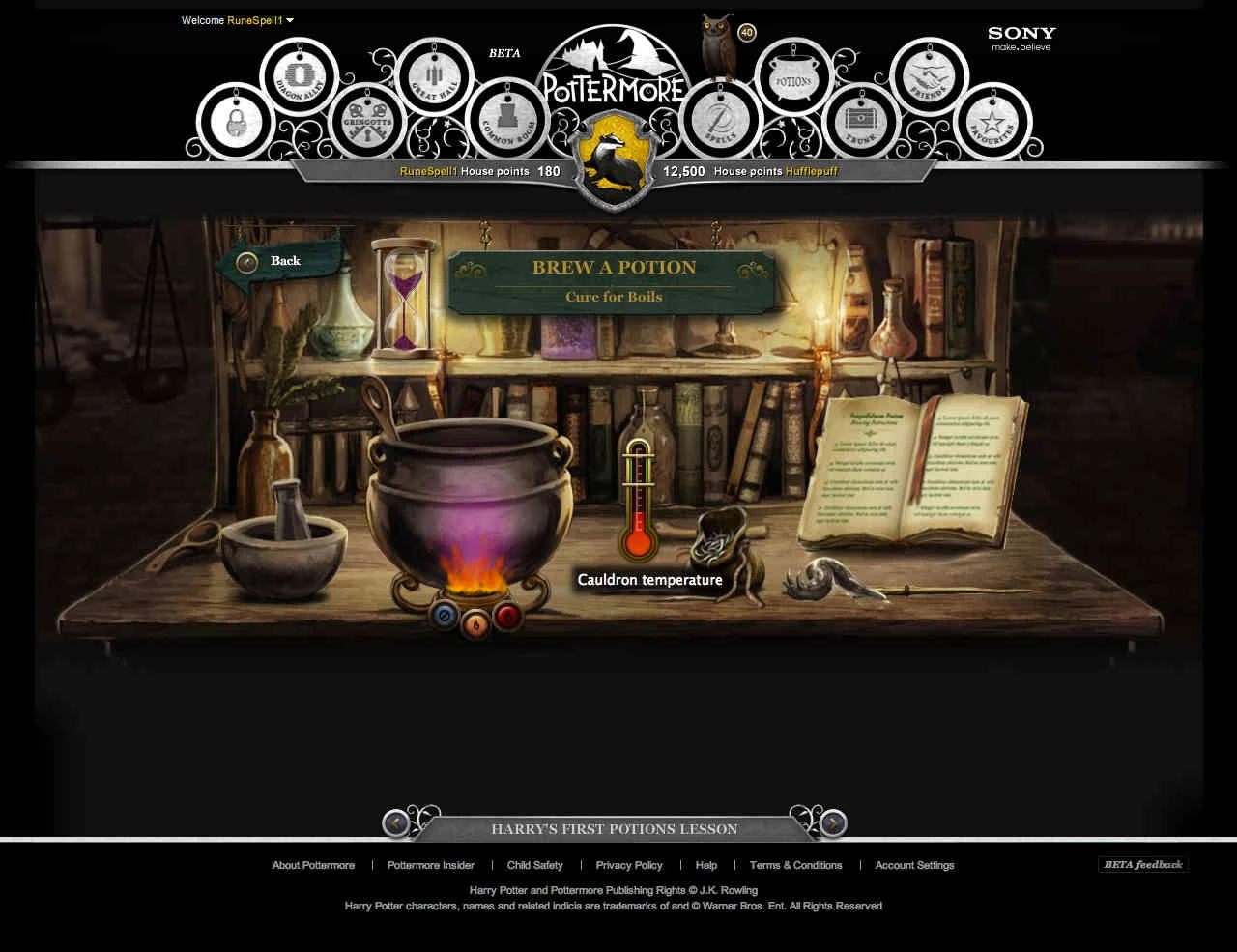
Pottermore Page (Wikia)
Perhaps, the largest example of transmedia in the Potter-verse is the creation of Pottermore. The website, which launched in 2011, was the first time that the Harry Potter brand went from a mostly multimedia focused one to a transmedia brand. While the site was also created with the idea of selling Potter e-books for the first time, through user participation where people are encouraged to play as though they are part of the world, it also expands the canon that already exists and ultimately enhances the viewing of the films or readings of the books rather than feeling as though one is already playing through something they’ve experienced once or twice before.

Where Rowling and those involved with Harry Potter and its expansion get it right is in their ability to make everything feel like an immersive experience. Not only do they expand their universe through virtual formats, but they go as far as adding things to theme park rides and studio tours for the films. Every new addition to the Harry Potter brand results in a new addition to the canon, and for fans, that’s something that can last long after the books have been written and the movies have been seen.

Transmedia is slowly becoming the new normal, especially in regards to films and how they are marketed to an audience. With franchises taking over the box office, it seems as though there’s an urge to take these films home with them and let the experience stick with them after an initial viewing. For the studios, there’s more of an incentive to create experiences like this for fans, since they receive money from things that are successful and can use the various points of entry to boost the popularity for their main focus, the films themselves. If nothing else, it’s something to hold the people over until the next sequel comes along.

Works Cited
Jenkins, Henry. Convergence Culture: Where Old and New Media Collide. New York: New York UP, 2006. Print.

Humphrey, Michael. "Pottermore: Expert Explains How Harry Potter's Website Will Transform Storytelling." Forbes. July 29, 2011. Accessed November 17, 2015. http://www.forbes.com/sites/michaelhumphrey/2011/07/29/pottermore-expert-explains-how-harry-potters-website-will-transform-storytelling/2/.


Multimedia v Transmedia Post #3 (Ali Ismail). A Grand Story Across Media and Space

       If there's one thing an audience can enjoy it's a great story whether on a relatable realistic level or a grand journey in a mythical land of untold riches. Part of what's great about being a Video Production Major and creating narrative videos is that we are able to create our own worlds whether based on reality or fiction to convey the message we desire. Movies being a visual medium help greatly in order to make stories more accessible to the general audience as people usually prefer to watch a movie over reading a book, especially now in this more digital age. However when we get to having a great story a large amount of people enjoy, one of two things happen. Either the story is preserved and kept the same and simply retold throughout time either in the same or separated media, or the story is expanded upon in other forms of media and work. This right here is what we call respectively multimedia works and transmedia works.


Cartoon drawing depicting the topic of
discussion: Multimedia vs Transmedia
Drawn by myself in Photoshop.
       Before we can delve into multimedia and transmedia work, it's important to understand what the difference is between the two works as by name they sound similar and are easy to confuse. A Youtube video by One 3 Productions titled "Transmedia 101" gives a simple to understand definition of both terms that through visuals helps to explain the difference between the two. According to the video, multimedia is "telling a single story in multiple mediums" (Transmedia 101 One 3 Productions, Youtube. the link to video here ). This means you take one established story and tell that same story through multiple mediums such as books, movies, games, and more. An example of this comes from popular series such as Harry Potter that started off as a book by J.K Rowling, made into a film, and then have games of the movie released.

Movie poster of the 1st Harry Potter film.
Taken from this website
Front cover of the 1st Harry Potter book
by J.K Rowling. Picture taken from
this website


Front and back cover of 1st Harry Potter game
based on the movie based on the book. Picture
taken from this website
What makes Harry Potter a multimedia piece of work is throughout these different mediums, the same story is being told. It utilizes these different pieces of medium to gain a wider audience to people who may be experiencing Harry Potter for the first time. While of course the game and film is condensed as a book can be read at the reader's desired pace while a film is restricted to normally not go past a 3 hour runtime, they all tell the same story. I've read the book, watched the film, and played the game (which like most licensed games are made just to cash in on the idea through an interactive medium so ordinarily fleshing out a new story isn't the focus) and it all told the same story, but through different mediums. Reboots of movies
      However transmedia work differs from multimedia work through one main idea. Multimedia utilizes different media sources to tell one story. According to the Youtube video from earlier, transmedia can be simply defined as, "telling multiple stories over multiple mediums that fit together to tell one big pervasive story" (Transmedia 101 One 3 Productions, Youtube. Video link here ). What can make it confusing to some is that transmedia utilizes multiple mediums to tell multiple stories, which you would think would be the definition of multimedia. However the key distinction is transmedia utilizes its multiple mediums to tell one story all linked together. While it may be considered a grey line, reboots or reimagining of films are an example of transmedia storytelling. A reimagining of a film takes the same premise of the original film but retells the story in a different way through another director's vision and eyes (The Trek BBS, website) .

Movie poster of Planet of the Apes
by Tim Burton, a reimagining of the
original film. Taken fromthis website
A reboot however is a retelling of a story that does not refer to its previous iterations and makes its own world. This is commonly seen nowadays in superhero films such as the Spider Man and Batman reboots. However these films all join together to tell multiple stories of said superheroes through multiple mediums. The idea of retelling a story has been around since the earliest forms of human civilization. There's even an argument now that our current superhero stories are similar to the stories of Greek and Roman Gods (The Guardian, website. Link here ). In class we discussed about how superheroes are great examples of transmedia storytelling, but however the discussion was primarily based on Marvel's superheroes. DC however has two iconic superheroes that have lasted decades through transmedia storytelling.
       It's very easy to see the idea of transmedia storytelling in everyone's favorite DC caped crusader and the arguable reason the superhero genre is revived, Batman.

"I am vengence. I am the night. I AM BATMAN"
Picture from the cartoon series Batman. Taken from
this website

Batman has a plethora of transmedia versions of his story. There's the comic books, the 60s Adam West TV show, the Tim Burton films in the 90s, various video games that explore new Batman continunities such as the Arkham Asylum trilogy being notoriously popular among fans for being a great Batman story AND a great game, crossover comics such as The Justice League, the Christopher Nolan films such as The Dark Knight, various cartoon series, the new live TV show simply titled Gotham, and a whole lot more.

Holy cow!!! That's a lot of Batmans.
Taken from this website
       Batman is one of the kings when it comes to transmedia storytelling as he covers almost every base and has been around for almost 70 years. Everyone knows of the Batman in some way or form because of the large access of Batman stories there are for anybody to get started in. Whether your a fan of movies, video games, television, there is a Batman story for you to begin to be absorbed into the grand fictional world. Batman engages participation in this sense because of not only how easy it is to get into the series and how many options there are, but from how realistic the idea of Batman is. There's no way anybody can be like Spider Man or the Hulk or Superman, its just unrealistic. Batman however is someone who has endured great pain and has gone through intense training to better himself as a person, an idea thats believable and desirable from an audience (Girloncomicbookworld, Website. Link here ). Among those traits he also has a large amount of wealth, which is a more believeable obtainable goal that radiation/mutation or being a part of an alien race) and fights for good. He's an endearing character with a lot of depth in him, his stories, his villians, and his multiple worlds.
       The fact that Batman utilizes all these medium sources help Batman out greatly to remain relevant. Batman started off as a comic book series, a medium that is not as popular in this day and age and would not last 70 years just as a comic. Expanding to other mediums such as television in the 60s around the time television was brand new helped to popularize the series. From there the series kept on building with movie adaptations, games that were released on the newest console, and much more. There's so many Batmans that someone could be a fan just by watching the Nolan films, or by just playing the Arkham video game trilogy. There's a piece of Batman everywhere, and it's easily accessible with all these media options.
       After looking at a large popular version of transmedia storytelling and based on what I've learned and research, I'm going to make a bold prediction on a new medium that I predict will become popular in months time and become a transmedia work. I am referring to the Indie Game released a month ago made alone by Toby Fox, Undertale.

Title screen of the game. Taken from this website
To briefly summarize the game without spoilers as it is a very story driven game and would ruin the experience, Undertale is a game where a human child falls into an underground world inhabited by monsters and has to make his way back home. The selling point of the game is something that breaks the mold of a traditional RPG game, you do not have to kill any enemy in the game. It has a unique morality system where the game remembers the actions you have done even in multiple playthroughs and cleverly utilizes 4th wall breaks to make the player take it's message seriously that it's not just making fun of you. There's 3 main endings to the game: A Neutral Path that players that treat the game like a standard RPG are most likely to get their first time playing, a True Pacifist ending where you do not kill a single enemy and befriend every major boss, and finally a Genocide Run where you actively kill every single monster in each area of the game and kill everyone. It breaks the mold of what's expected in an RPG game and has fantastic visuals, soundtrack, and endearing loving characters and world. Needless to say, Undertale has taken the Internet by storm being the highest rated PC game for a moment according to a tweet from the creator of the game.
       I feel that Undertale will become a transmedia form of storytelling in the future because it meets the criteria of transmedia as well as becoming rapidly popular in such a short amount of time. The same concept happened with Baratunde Thurston's #how to be black that quickly became popular and eventually became a book. Undertale ends its Happy Ending with the characters entering a new world leaving the possibility for a sequel or retelling of the story through the game's achknowledgement of multiple timelines. Hidden in the game are secrets that expand the story even further that are left purposefully by the game creator, who also states he plans to make a continuation comic of the game's story. In the meantime there is tons of fanart all over sites such as Twitter or Tumblr that depict people's interpretations of alternate worlds or continuations of Undertale's story such as this comic that depicts an alternate world where the monsters are inherently violentor this one here. There are much more examples out there and I wanted to prevent linking the ones that contain massive story spoilers to the game, but those are to just name a few. The game is very new and has only been out for two months. However with how many people its touched through its message, morals, and story, and how it proves video games can be a high form of art that can be just as effective as cinema, I am confident and would not be surprised if Undertale becomes a transmedia phenomenon that everyone will soon know the name of.
       Whether multi or transmedia, a great story and world are ideas we all value. It's amazing to think that many of the things we enjoy now will be told in new ways 20 years from now. The kids we have are going to see our favorite games and comic book heroes in new light, and we can still show to them the stories we grew up with to further expand their enjoyment and keep the story connected through transmedia storytelling.

Works Cited
"Batman Day: Why Is Batman so Popular?" GirlonComicbookWorld. N.p., 26 Sept. 2015. Web. 8 Nov. 2015.
"Define "reboot" vs. "remake" vs. "reimagining" - The Trek BBS." Define "reboot" vs. "remake" vs. "reimagining" - The Trek BBS. The Trek BBS, 26 Aug. 2011. Web. 10 Nov. 2015.
HCDMediaGroup. "Henry Jenkins" Online video clip. Youtube, 21 September 2009. Web. 6 Nov. 2015
Gordon, Ullyses. “What is Transmedia?” Online video clip. Youtube, 17 October 2010.           Web. 5 Nov. 2015. 
Jones, Jonathan. "Batman Steps on Achilles Heel." The Guardian. The Guardian, 28 Nov. 2008. Web. 11 Nov. 2015.
Moloney, Kevin. "Multimedia, Crossmedia, Transmedia...What's in a Name?" Transmediajournalism. N.p., 21 Apr. 2014. Web. 14 Nov. 2015.
One 3 Productions. “Transmedia 101 by One 3 Productions”. Online video clip. Youtube, 24 June 2011. Web. 5 Nov. 2015
O'Reiley. "TOC 2012: Baratunde Thurston "Keynote" " Online video clip. Youtube, 14 February 2012. Web. 5 Nov. 2015
Undertale. 1.0 Toby Fox. 2015. Video Game.